
Hello, lovely homeowners! It’s your friendly neighborhood home inspector, and today I am writing about push-matic electrical panels.
If homes had personalities, some electrical panels would be calm librarians. Others would be overcaffeinated air traffic controllers.
And then there’s the Push-matic panel. The old school rebel of the basement. 🧰⚡
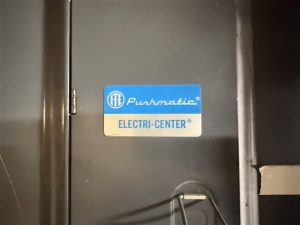
Pushmatic panels were manufactured by Bulldog Electric Products Company beginning in the 1950s and later by ITE Imperial Corporation. When most electricians or home inspectors warn about dangerous electrical panels three names often come up: Bulldog Pushmatic, Federal Pacific Stab Lok or Zinsco. They were commonly used from 1950-1970s. They are instantly recognizable by the push button breakers.
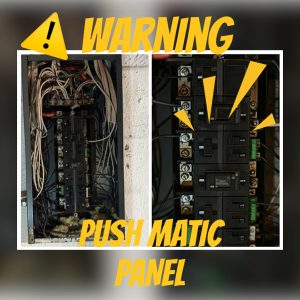
Instead of the toggle switches most of us are used to, Pushmatic breakers use… buttons.
Yes. Buttons.
You push them in to turn the breaker on. Push again to turn it off. No satisfying flip. No dramatic snap. Just a firm little mechanical click like you’re starting a 1963 dishwasher.
At first glance, they look sturdy. And to be fair, many of them were built like tanks.
But tanks also belong in museums. At the time, they were seen as innovative. But now those panels have become outdated and maybe even dangerous. The replacement breakers are difficult to find and when your power is out, you want easy peasy.
When I see one during an inspection, I don’t panic. I also don’t throw confetti.
Here’s why they get flagged:
Most Pushmatic panels are 50 to 70 years old. Even if they’re still functioning, electrical components are not immortal. Springs fatigue. Contacts wear. Internal mechanisms age quietly.
Electricity never ages quietly.
Pushmatic breakers are known for becoming difficult to operate over time. Sometimes they feel like you’re trying to press a stubborn elevator button in a haunted hotel.
Identifying the state of the breaker ON/OFF is sometimes unclear. Push-matic breakers have an indicator flag showing whether the circuit is ON or OFF. Many times, on old Push-Matic breakers, this on/off flag will stay fixed in either position, giving you a false indication of the condition of the circuit. As a rule, don’t mess with false positives.
If a breaker doesn’t move easily, that’s a concern. Breakers need to operate reliably during a fault condition. That’s their whole job.
Some Pushmatic panels lack a single main breaker. That means shutting off power to the entire panel can require turning off multiple breakers. In today’s electrical heavy world, that could make some two year olds watching Bluey very unhappy.
In an emergency, that’s less than ideal.
Breakers are designed to trip in the event of an issue. This protects your system from overheating and starting a fire. This failure to trip leaves circuits dangerously energized during faults. Push Matic & Bulldog circuit breakers use a thermal breaker design with no magnetic trip mechanism. Modern breakers incorporate both magnetic and thermal tripping mechanisms, increasing safety and the likelihood that they will function properly in the event of an overload or short circuit. Constant blown circuits and we are back to that unhappy two year old.
Replacement breakers are not typically sitting on the shelf at your local hardware store. They can be more expensive and harder to source than modern equivalents. Some may even resort to aftermarket or refurbished products. Even basic repairs become a hassle.
Modern panels are built with widely available components. Pushmatic? More of a specialty item at this point.
Here’s the honest, inspector answer:
They are not automatically unsafe. In fact, one of our employees bought a home with one.
But…
They are outdated.
They are harder to service.
They lack modern safety features.
And many electricians recommend upgrading simply due to age and parts availability.
Electrical systems are not the place to gamble on nostalgia. Most Push-matic systems run on 60-100 amps. This is far below the typical 200 amps found in today’s residential systems. This increases risks of overloaded circuits and potentially fires. .
That depends on:
If you’re adding a hot tub, EV charger, or finishing a basement, an older Pushmatic panel may not be the ideal foundation. They are not built for today’s electrical safety standards. Waiting until there is a problem could mean dealing with power loss, fire damage or worse. There is no way to predict how long one of these panels has left. Often they work until they don’t and by then, it might be too late.
Think of it like running modern software on a 1960s computer. Impressive if it works. Stressful if it doesn’t.
When I find a Push-matic panel, I explain:
It’s not about scaring anyone. It’s about understanding the system you’re buying into.
Knowledge beats surprise repairs every time.
Push-matic panels are a fascinating piece of electrical history. They’ve powered homes faithfully for decades.
But today’s homes demand more.
More appliances.
More technology.
More safety standards.
If your home has a Pushmatic panel, it may still be working fine. It may also be living on borrowed time. Your electrical system is the backbone of your home. Upgrading impacts your investment, your family and your piece of mind.
And that’s exactly why a thorough home inspection matters.
If you’re buying a home in the metro Ann Arbor area and want to know whether your electrical panel is vintage charm or future project… let’s take a look. As a part of every home inspection, Integrity Inspection Group evaluates the electrical system, including outdated and potentially hazardous main panels.
Because when it comes to electricity, guessing is not a strategy. ⚡🏠

